
HERITAGE VISUALISATION & HBIM TRAINING
ONLINE TRAINING COURSES AVAILABLE:
- Autodesk Revit – Introduction to HBIM
- Autodesk Revit to Unreal Engine 5 – HBIM Data Transfer
- Introduction to Twinmotion
- Intermediate Twinmotion
- Unreal Engine Heritage Visualisation & Storytelling
- Twinmotion – Heritage Visualisation & Storytelling
- Creating Parametric Families for Historic Building Elements
- Modelling 3D Heritage Assets
Alongside the publication of my first book at the end of Sept 2025, titled ‘Recreating Built Heritage for Cities – Creating Accurate HBIM 3D Buildings for Use in Unreal Engine 5’ (see details below), we have put together a range of 1 & 2 day online courses to help you either work through some of your own heritage building information modelling (HBIM) projects or starting from scratch with ones we may have.
There is not a set schedule with regards dates, instead please contact us and we will work with you as much as is feasibly possible on dates that suit you.
The fee is £250 per day, 2 day courses can be split rather than consecutive if that helps with your own commitments re work. Each day would start at 10am and finish at the latest 5pm. Half days can also be considered.
If you would like to talk through your requirements and therefore how many days might be required, please contact us via email (info@virtualcities.uk) initially to arrange a phone call.
Course Outlines:
- Autodesk Revit – Introduction to HBIM
- Autodesk Revit to Unreal Engine 5 – HBIM Data Transfer
- Introduction to Twinmotion 2023
- Intermediate Twinmotion 2023
- Introduction to Twinmotion 2025.2
- Intermediate Twinmotion 2025.2
- Unreal Engine Heritage Visualisation & Storytelling
- Twinmotion – Heritage Visualisation & Storytelling
- Creating Parametric Families for Historic Building Elements
- Modelling 3D Heritage Assets
Publications:
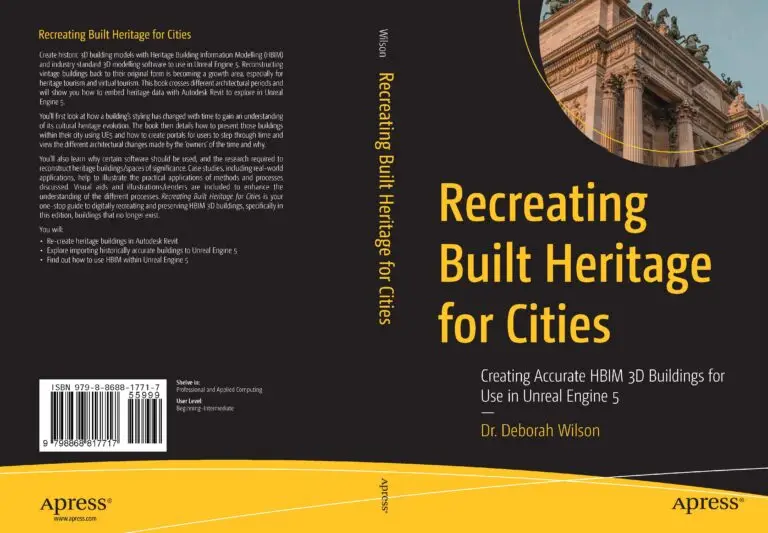
Recreating Built Heritage for Cities – Creating Accurate HBIM 3D Buildings for Use in Unreal Engine 5 by Dr Deborah Wilson, published by Apress. ISBN 979-8-8688-1771-7 (end of Sept 2025)
This new book aims to help professionals and students work through the process of recreating past times of a city and bring them to life for visitors to engage with the culture and heritage of a city across different time periods. The practical elements, exercises and tutorials work alongside the development of a live project ‘Virtual Cities-Winchester – 1400 & 1800’ and will highlight the challenges of historical research and inputting of heritage information to ensure accurate representation.
Explanation of why certain software should be used and the research required to reconstruct heritage buildings/spaces of significance is provided. In addition, how to represent buildings for which data cannot be found will be discussed.
Case studies including real world applications will form part of each chapter of the book and help to illustrate the practical applications of methods and processes discussed. Visual aids and illustrations/renders will be included to enhance the understanding of the processes and further engage the readers.
The book will provide a step-by-step process in creating HBIM buildings and a subsequent city using industry standard software, taking the models into Unreal and reconstructing a city in two time periods to show the evolution of the city. In addition, the book will detail the importance of cultural heritage passed on through HBIM and storytelling via gamification and exploration of the city in different time periods. This book is an instructional book with tutorials/exercises and a live example to follow (Jane Austen’s family home Steventon Rectory in Hampshire, UK), with theory and explanations for readers to understand the importance of BIM, HBIM and the different areas related to this and the software they are using.
It will also explain the importance of historical research and software required in reconstructing heritage buildings and significant spaces including architectural analysis, and collaboration with historians and experts in the field, therefore providing a valuable resource for readers interested in architecture, historical preservation, and urban planning
In summary, this book has been planned as a resource for architects, historians, urban planners, heritage enthusiasts, virtual technologists and film/game professionals using Unreal Engine to recreate 3d worlds/environments. It would also be valuable for students on degree programmes studying/creating 3D Environments, Architecture, Level Design and 3D Modelling.